



DevSecOps vs. DevOps is a conversation we consider settled – or at least we pretend to, hoping the rest of the industry will catch up.
Security had to be integrated. That’s the reality. What once was called DevSecOps has now largely been folded into DevOps itself – by necessity, not by marketing. When companies today post for “DevOps engineers,” what they’re really asking for is someone fluent in secure automation, policy-as-code, and compliance-aware deployment. The term “DevSecOps” has served its purpose. It redefined DevOps.
And yet, distinctions still matter. Some organizations and recruiters still treat security as a late-stage gate, not an embedded capability. So this article serves as both a post-mortem and a gentle reminder: the only real DevOps is the secure kind.
What Was DevOps?
Before diving into the security shift, let’s revisit the foundation. DevOps originally referred to a set of practices that automate processes between software development and IT operations teams. The goal was to build, test, and release software faster and more reliably.
Key principles included:
- Enhanced collaboration across teams.
- Extensive automation of build, test, and deployment processes.
- Continuous Integration (CI) and Continuous Delivery (CD).
Together, these practices shortened the SDLC and enabled faster responses to business needs. But security remained a separate function – rarely integrated early enough to prevent costly fixes.
The Shift Left Misunderstanding
DevSecOps emerged to close that gap, embedding security throughout the lifecycle – not bolting it on at the end. It introduced the idea of “Shift Left,” which originally encouraged teams to surface vulnerabilities earlier in development. But this was often misunderstood as front-loading security only in planning or design.
In reality, security needs to be present everywhere. It has to travel with the work, not just lead or follow it. In a continuous delivery loop, security isn’t a phase – it’s a posture. It needs to be continuous – woven through the feedback loops of modern delivery, neither ending nor merely initiating it.
DevOps transformed the delivery lifecycle by prioritizing automation, collaboration, and rapid iteration. But speed alone introduced a new problem: unmitigated risk. For many organizations, security was bolted on at the end – or handed off to isolated teams with little context or authority.
DevSecOps emerged not as a buzzword, but as a necessary correction. In regulated and complex environments – finance, government, healthcare – security isn’t optional, and treating it like an afterthought doesn’t scale. This framework puts it where it belongs: inside the pipeline, embedded and automated.
What DevSecOps Actually Changes
One developer once joked to me – half-serious – “If there’s a security team at the end of the pipeline, why should I waste time writing secure code?” That mindset still lingers in some organizations. It’s not cynicism – it’s the result of poorly structured workflows that shift responsibility downstream.
The real issue? Not speed. Not even pressure. It was silos – often misattributed to the principle of separation of concerns, which was never meant to justify separating security from delivery. Secure DevOps breaks those silos by making security a continuous layer – not a step.
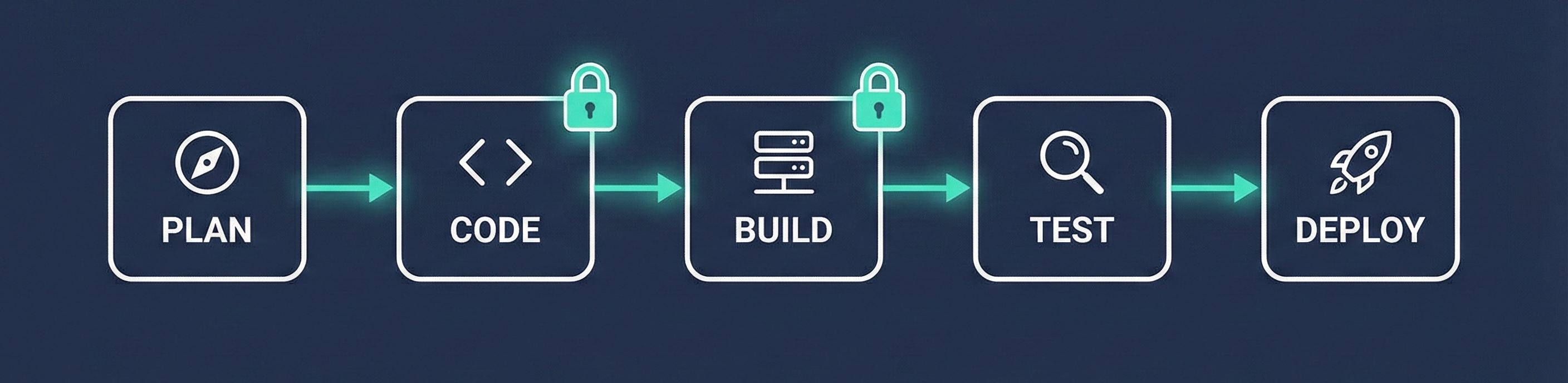
In mature pipelines, you’ll see security checks tied to:
- Code reviews: SAST (Static Application Security Testing) and pre-commit secrets detection.
- Dependency management: SCA (Software Composition Analysis) and SBOM policies.
- Infrastructure as Code validation: Scanning Terraform, Helm, or Ansible for misconfigurations.
- Container hygiene: Base image vulnerabilities, signing, and policies.
- Deployment gates: OPA (Open Policy Agent), Kyverno, and admission controllers.
- Runtime protection: RASP, EDR, and behavioral anomaly detection.
The Cost of Getting It Wrong (2025 Data)
Security delayed is cost multiplied. That’s not a metaphor – it’s quantifiable. Industry data overwhelmingly shows that delaying security drastically increases remediation costs and timelines.
According to the 2024 IBM Cost of a Data Breach Report, the average cost of a data breach globally has reached $4.88 million. However, organizations that leverage AI and automation in their security workflows – a core tenet of modern DevSecOps – see significant savings, averaging $2.2 million less in breach costs compared to those who don’t.
Furthermore, the “Rule of 100” remains a critical economic driver for shifting left:
| SDLC Stage | Relative Cost to Fix (vs. Design) | Impact |
| Design | 1x | Minimal |
| Coding / Unit Testing | ~10x | Minor Rework |
| Integration / Testing | ~100x | Significant Rework |
| Production / Post-Release | 640x – 1,000x | Emergency Hotfixes, Brand Damage |
(Sources: IBM Systems Sciences Institute; CloudQA: The True Cost of Software Bugs in 2025)
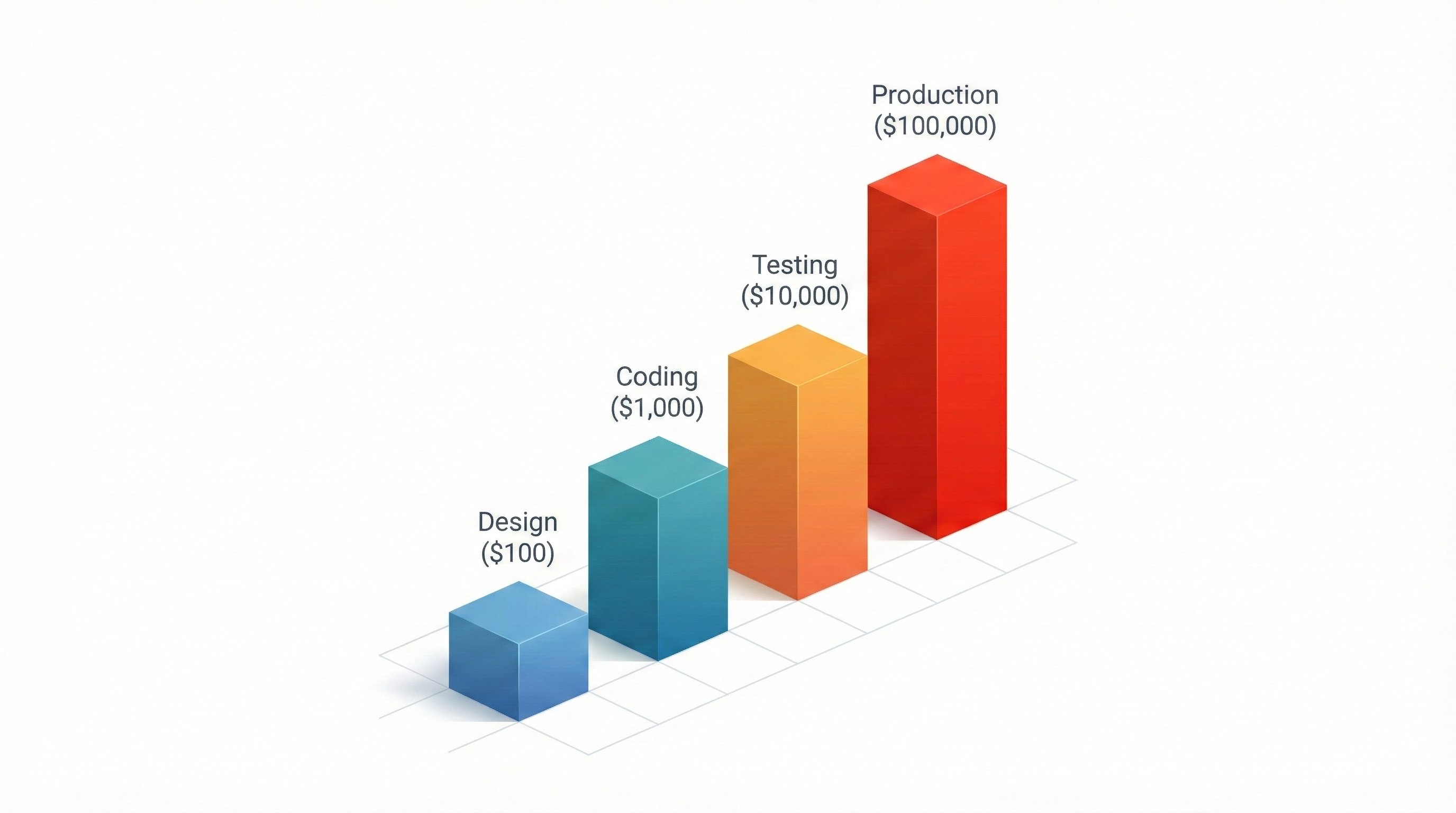
A delay of just one month in implementing security-by-design across 100 applications can inflate remediation costs by over $416,000.
Real-World Success with DevSecOps
The theoretical benefits translate into tangible results for major organizations:
- Target reportedly reduced operational costs by 40% and increased online sales by 3% by adopting DevOps principles with embedded security.
- stc Group successfully reduced the deployment time for new applications by 50% by strengthening their DevSecOps capabilities with Red Hat.
- Sonatype reports that mature teams remediate critical vulnerabilities 2.6× faster than those less mature.
- The Verizon DBIR has historically linked integrated security practices to experiencing 50% fewer security incidents.
The Wider World of *Ops: Beyond DevSecOps
The success of DevOps has inspired specialized methodologies that apply similar principles to different domains. For Zero One Logic clients navigating complex architectures, understanding these distinctions is vital.
BizDevSecOps
This takes DevSecOps a step further by explicitly integrating Business goals. It aligns Business value, Development speed, Operational stability, and Security. It ensures that security gates reflect actual business risk – preventing “security theater” where low-risk apps are slowed down by high-risk protocols.
MLOps (Machine Learning Operations)
As AI becomes central to enterprise strategy, MLOps applies DevOps principles to the machine learning lifecycle. It handles data versioning, model drift detection, and automated retraining. Crucially, Securing MLOps is the new frontier – protecting training data from poisoning and models from inversion attacks.
(Learn more about our AI & Machine Learning capabilities here.)
Platform Engineering & GitOps
In 2025, DevSecOps is often delivered via Platform Engineering. By building an Internal Developer Platform (IDP), organizations provide a “Golden Path” where security is pre-configured. GitOps complements this by using Git as the single source of truth for infrastructure, ensuring that any unauthorized change in production is immediately detected and reverted.
But Do You Need All This for Every Project?
Not every app handles sensitive data. Not every repo is public. But threat actors rarely attack what’s obvious. Internal tools, staging environments, CI systems themselves – these often become the weakest link.
If you lower standards just because something is “internal,” you train teams to expect lax expectations. Keep the standards firm, and both your tools and your people stay hardened against complacency.
Closing Perspective
If the term “DevSecOps” feels redundant today, that’s a good thing. It means the principles behind it were absorbed into modern DevOps practice. But we still see job descriptions and organizational charts that split security from delivery – or worse, skip it altogether.
This article is here as a reference point: a line in the sand for what DevOps must always include, even when the name no longer makes the distinction. In regulated, cloud-native, or fast-scaling environments, it’s not optional. And it’s not difficult – unless you wait too long to start.
If you’re navigating these challenges or planning your own secure delivery architecture, Zero One Logic is ready to share what works – and what doesn’t. Reach out anytime.